|
JSBSim Flight Dynamics Model
1.0 (02 March 2017)
An Open Source Flight Dynamics and Control Software Library in C++
|
|
JSBSim Flight Dynamics Model
1.0 (02 March 2017)
An Open Source Flight Dynamics and Control Software Library in C++
|
The trimming routine for JSBSim. More...
#include <FGTrim.h>
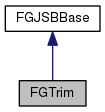
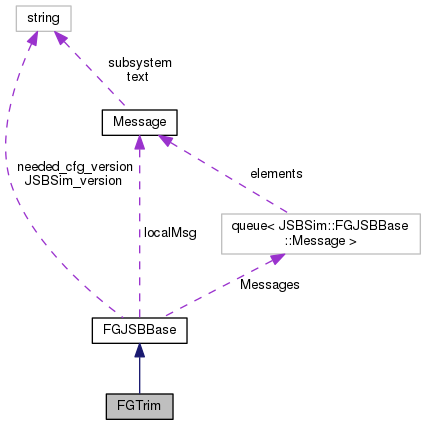
 Inheritance diagram for FGTrim: Collaboration diagram for FGTrim:
Public Member Functions | |
| FGTrim (FGFDMExec *FDMExec, TrimMode tm=tGround) | |
| Initializes the trimming class. More... | |
| bool | AddState (State state, Control control) |
| Add a state-control pair to the current configuration. More... | |
| void | ClearDebug (void) |
| void | ClearStates (void) |
| Clear all state-control pairs from the current configuration. More... | |
| void | DebugState (State state) |
| Output debug data for one of the axes The State enum is defined in FGTrimAxis.h. | |
| bool | DoTrim (void) |
| Execute the trim. | |
| bool | EditState (State state, Control new_control) |
| Change the control used to zero a state previously configured. More... | |
| bool | GetGammaFallback (void) |
| query the fallback state More... | |
| double | GetTargetNlf (void) |
| bool | RemoveState (State state) |
| Remove a specific state-control pair from the current configuration. More... | |
| void | Report (void) |
| Print the results of the trim. More... | |
| void | SetDebug (int level) |
| Debug level 1 shows results of each top-level iteration Debug level 2 shows level 1 & results of each per-axis iteration. | |
| void | SetGammaFallback (bool bb) |
| automatically switch to trimming longitudinal acceleration with flight path angle (gamma) once it becomes apparent that there is not enough/too much thrust. More... | |
| void | SetMaxCycles (int ii) |
| Set the iteration limit. More... | |
| void | SetMaxCyclesPerAxis (int ii) |
| Set the per-axis iteration limit. More... | |
| void | SetMode (TrimMode tm) |
| Clear all state-control pairs and set a predefined trim mode. More... | |
| void | SetTargetNlf (double nlf) |
| void | SetTolerance (double tt) |
| Set the tolerance for declaring a state trimmed. More... | |
| void | TrimStats () |
| Iteration statistics. | |
| Public Member Functions inherited from FGJSBBase | |
| FGJSBBase () | |
| Constructor for FGJSBBase. | |
| virtual | ~FGJSBBase () |
| Destructor for FGJSBBase. | |
| void | disableHighLighting (void) |
| Disables highlighting in the console output. | |
| std::string | GetVersion (void) |
| Returns the version number of JSBSim. More... | |
| void | PutMessage (const Message &msg) |
| Places a Message structure on the Message queue. More... | |
| void | PutMessage (const std::string &text) |
| Creates a message with the given text and places it on the queue. More... | |
| void | PutMessage (const std::string &text, bool bVal) |
| Creates a message with the given text and boolean value and places it on the queue. More... | |
| void | PutMessage (const std::string &text, int iVal) |
| Creates a message with the given text and integer value and places it on the queue. More... | |
| void | PutMessage (const std::string &text, double dVal) |
| Creates a message with the given text and double value and places it on the queue. More... | |
| int | SomeMessages (void) |
| Reads the message on the queue (but does not delete it). More... | |
| void | ProcessMessage (void) |
| Reads the message on the queue and removes it from the queue. More... | |
| Message * | ProcessNextMessage (void) |
| Reads the next message on the queue and removes it from the queue. More... | |
Additional Inherited Members | |
| Public Types inherited from FGJSBBase | |
| enum | { eL = 1, eM, eN } |
| Moments L, M, N. | |
| enum | { eP = 1, eQ, eR } |
| Rates P, Q, R. | |
| enum | { eU = 1, eV, eW } |
| Velocities U, V, W. | |
| enum | { eX = 1, eY, eZ } |
| Positions X, Y, Z. | |
| enum | { ePhi = 1, eTht, ePsi } |
| Euler angles Phi, Theta, Psi. | |
| enum | { eDrag = 1, eSide, eLift } |
| Stability axis forces, Drag, Side force, Lift. | |
| enum | { eRoll = 1, ePitch, eYaw } |
| Local frame orientation Roll, Pitch, Yaw. | |
| enum | { eNorth = 1, eEast, eDown } |
| Local frame position North, East, Down. | |
| enum | { eLat = 1, eLong, eRad } |
| Locations Radius, Latitude, Longitude. | |
| enum | { inNone = 0, inDegrees, inRadians, inMeters, inFeet } |
| Conversion specifiers. | |
| Static Public Member Functions inherited from FGJSBBase | |
| static double | CelsiusToFahrenheit (double celsius) |
| Converts from degrees Celsius to degrees Fahrenheit. More... | |
| static double | CelsiusToKelvin (double celsius) |
| Converts from degrees Celsius to degrees Kelvin. More... | |
| static double | CelsiusToRankine (double celsius) |
| Converts from degrees Celsius to degrees Rankine. More... | |
| static double | Constrain (double min, double value, double max) |
| Constrain a value between a minimum and a maximum value. | |
| static bool | EqualToRoundoff (double a, double b) |
| Finite precision comparison. More... | |
| static bool | EqualToRoundoff (float a, float b) |
| Finite precision comparison. More... | |
| static bool | EqualToRoundoff (float a, double b) |
| Finite precision comparison. More... | |
| static bool | EqualToRoundoff (double a, float b) |
| Finite precision comparison. More... | |
| static double | FahrenheitToCelsius (double fahrenheit) |
| Converts from degrees Fahrenheit to degrees Celsius. More... | |
| static double | FeetToMeters (double measure) |
| Converts from feet to meters. More... | |
| static double | GaussianRandomNumber (void) |
| static double | KelvinToCelsius (double kelvin) |
| Converts from degrees Kelvin to degrees Celsius. More... | |
| static double | KelvinToFahrenheit (double kelvin) |
| Converts from degrees Kelvin to degrees Fahrenheit. More... | |
| static double | KelvinToRankine (double kelvin) |
| Converts from degrees Kelvin to degrees Rankine. More... | |
| static double | MachFromVcalibrated (double vcas, double p, double psl, double rhosl) |
| Calculate the Mach number from the calibrated airspeed. More... | |
| static double | PitotTotalPressure (double mach, double p) |
| Compute the total pressure in front of the Pitot tube. More... | |
| static double | RankineToCelsius (double rankine) |
| Converts from degrees Rankine to degrees Celsius. More... | |
| static double | RankineToKelvin (double rankine) |
| Converts from degrees Rankine to degrees Kelvin. More... | |
| static double | sign (double num) |
| static double | VcalibratedFromMach (double mach, double p, double psl, double rhosl) |
| Calculate the calibrated airspeed from the Mach number. More... | |
| Static Public Attributes inherited from FGJSBBase | |
| static short | debug_lvl = 1 |
| static char | highint [5] = {27, '[', '1', 'm', '\0' } |
| highlights text | |
| static char | halfint [5] = {27, '[', '2', 'm', '\0' } |
| low intensity text | |
| static char | normint [6] = {27, '[', '2', '2', 'm', '\0' } |
| normal intensity text | |
| static char | reset [5] = {27, '[', '0', 'm', '\0' } |
| resets text properties | |
| static char | underon [5] = {27, '[', '4', 'm', '\0' } |
| underlines text | |
| static char | underoff [6] = {27, '[', '2', '4', 'm', '\0' } |
| underline off | |
| static char | fgblue [6] = {27, '[', '3', '4', 'm', '\0' } |
| blue text | |
| static char | fgcyan [6] = {27, '[', '3', '6', 'm', '\0' } |
| cyan text | |
| static char | fgred [6] = {27, '[', '3', '1', 'm', '\0' } |
| red text | |
| static char | fggreen [6] = {27, '[', '3', '2', 'm', '\0' } |
| green text | |
| static char | fgdef [6] = {27, '[', '3', '9', 'm', '\0' } |
| default text | |
| Protected Member Functions inherited from FGJSBBase | |
| void | Debug (int) |
| Static Protected Member Functions inherited from FGJSBBase | |
| static std::string | CreateIndexedPropertyName (const std::string &Property, int index) |
| Static Protected Attributes inherited from FGJSBBase | |
| static const double | degtorad = 0.017453292519943295769236907684886 |
| static const double | fpstokts = 1.0/ktstofps |
| static const double | fttom = 0.3048 |
| static int | gaussian_random_number_phase = 0 |
| static const double | hptoftlbssec = 550.0 |
| static const double | in3tom3 = 1.638706E-5 |
| static const double | inchtoft = 0.08333333 |
| static const double | inhgtopa = 3386.38 |
| static const std::string | JSBSim_version = "1.0 " __DATE__ " " __TIME__ |
| static const double | kgtolb = 2.20462 |
| static const double | kgtoslug = 0.06852168 |
| static const double | ktstofps = 1.68781 |
| static const double | lbtoslug = 1.0/slugtolb |
| static Message | localMsg |
| static const double | m3toft3 = 1.0/(fttom*fttom*fttom) |
| static double | Mair = 28.9645 |
| static unsigned int | messageId = 0 |
| static std::queue< Message > | Messages |
| static const std::string | needed_cfg_version = "2.0" |
| static const double | psftoinhg = 0.014138 |
| static const double | psftopa = 47.88 |
| static const double | radtodeg = 57.295779513082320876798154814105 |
| static double | Reng = 1716.56 |
| static double | Rstar = 1545.348 |
| static const double | SHRatio = 1.40 |
| static const double | slugtolb = 32.174049 |
The trimming routine for JSBSim.
FGTrim finds the aircraft attitude and control settings needed to maintain the steady state described by the FGInitialCondition object . It does this iteratively by assigning a control to each state and adjusting that control until the state is within a specified tolerance of zero. States include the recti-linear accelerations udot, vdot, and wdot, the angular accelerations qdot, pdot, and rdot, and the difference between heading and ground track. Controls include the usual flight deck controls available to the pilot plus angle of attack (alpha), sideslip angle(beta), flight path angle (gamma), pitch attitude(theta), roll attitude(phi), and altitude above ground. The last three are used for on-ground trimming. The state-control pairs used in a given trim are completely user configurable and several pre-defined modes are provided as well. They are:
The remaining modes include tCustom, which is completely user defined and tNone.
Note that trims can (and do) fail for reasons that are completely outside the control of the trimming routine itself. The most common problem is the initial conditions: is the model capable of steady state flight at those conditions? Check the speed, altitude, configuration (flaps, gear, etc.), weight, cg, and anything else that may be relevant.
Example usage:
Initializes the trimming class.
| FDMExec | pointer to a JSBSim executive object. |
| tm | trim mode |
Definition at line 65 of file FGTrim.cpp.
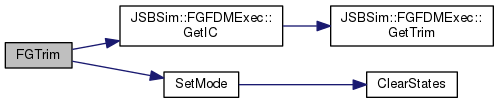
Here is the call graph for this function:| bool AddState | ( | State | state, |
| Control | control | ||
| ) |
Add a state-control pair to the current configuration.
See the enums State and Control in FGTrimAxis.h for the available options. Will fail if the given state is already configured.
| state | the accel or other condition to zero |
| control | the control used to zero the state |
Definition at line 134 of file FGTrim.cpp.
| void ClearStates | ( | void | ) |
Clear all state-control pairs from the current configuration.
The trimming routine must have at least one state-control pair configured to be useful
Definition at line 126 of file FGTrim.cpp.
Here is the caller graph for this function:| bool EditState | ( | State | state, |
| Control | new_control | ||
| ) |
Change the control used to zero a state previously configured.
| state | the accel or other condition to zero |
| new_control | the control used to zero the state |
Definition at line 175 of file FGTrim.cpp.
|
inline |
| bool RemoveState | ( | State | state | ) |
Remove a specific state-control pair from the current configuration.
| state | the state to remove |
Definition at line 152 of file FGTrim.cpp.
| void Report | ( | void | ) |
Print the results of the trim.
For each axis trimmed, this includes the final state value, control value, and tolerance used.
Definition at line 117 of file FGTrim.cpp.
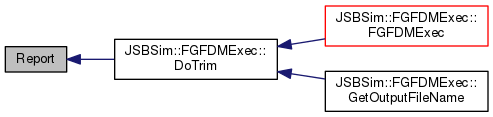
Here is the caller graph for this function:
|
inline |
|
inline |
|
inline |
Set the per-axis iteration limit.
Attempt to zero each state by iterating limit times before moving on to the next. The default limit is 100 and also does not ordinarily need to be changed.
| ii | integer iteration limit |
| void SetMode | ( | TrimMode | tm | ) |
Clear all state-control pairs and set a predefined trim mode.
| tm | the set of axes to trim. Can be: tLongitudinal, tFull, tGround, tCustom, or tNone |
Definition at line 796 of file FGTrim.cpp.
Here is the call graph for this function: Here is the caller graph for this function:
|
inline |
 1.8.13