|
JSBSim Flight Dynamics Model
1.0 (02 March 2017)
An Open Source Flight Dynamics and Control Software Library in C++
|
|
JSBSim Flight Dynamics Model
1.0 (02 March 2017)
An Open Source Flight Dynamics and Control Software Library in C++
|
Landing gear model. More...
#include <FGLGear.h>
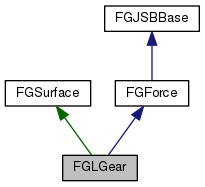
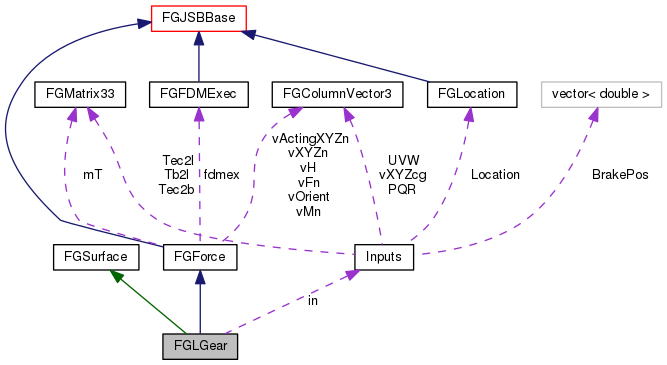
 Inheritance diagram for FGLGear: Collaboration diagram for FGLGear:
Classes | |
| struct | Inputs |
Public Types | |
| enum | BrakeGroup { bgNone =0, bgLeft, bgRight, bgCenter, bgNose, bgTail, bgNumBrakeGroups } |
| Brake grouping enumerators. | |
| enum | ContactType { ctBOGEY, ctSTRUCTURE } |
| Contact point type. | |
| enum | DampType { dtLinear =0, dtSquare } |
| Damping types. | |
| enum | FrictionType { ftRoll =0, ftSide, ftDynamic } |
| Friction types. | |
| enum | ReportType { erNone =0, erTakeoff, erLand } |
| Report type enumerators. | |
| enum | SteerType { stSteer, stFixed, stCaster } |
| Steering group membership enumerators. | |
| Public Types inherited from FGForce | |
| enum | TransformType { tNone, tWindBody, tLocalBody, tCustom } |
| Public Types inherited from FGJSBBase | |
| enum | { eL = 1, eM, eN } |
| Moments L, M, N. | |
| enum | { eP = 1, eQ, eR } |
| Rates P, Q, R. | |
| enum | { eU = 1, eV, eW } |
| Velocities U, V, W. | |
| enum | { eX = 1, eY, eZ } |
| Positions X, Y, Z. | |
| enum | { ePhi = 1, eTht, ePsi } |
| Euler angles Phi, Theta, Psi. | |
| enum | { eDrag = 1, eSide, eLift } |
| Stability axis forces, Drag, Side force, Lift. | |
| enum | { eRoll = 1, ePitch, eYaw } |
| Local frame orientation Roll, Pitch, Yaw. | |
| enum | { eNorth = 1, eEast, eDown } |
| Local frame position North, East, Down. | |
| enum | { eLat = 1, eLong, eRad } |
| Locations Radius, Latitude, Longitude. | |
| enum | { inNone = 0, inDegrees, inRadians, inMeters, inFeet } |
| Conversion specifiers. | |
Public Member Functions | |
| FGLGear (Element *el, FGFDMExec *Executive, int number, const struct Inputs &input) | |
| Constructor. More... | |
| ~FGLGear () | |
| Destructor. | |
| void | bind (void) |
| const FGColumnVector3 & | GetBodyForces (FGSurface *surface=NULL) |
| The Force vector for this gear. More... | |
| FGColumnVector3 | GetBodyLocation (void) const |
| Gets the location of the gear in Body axes. | |
| double | GetBodyLocation (int idx) const |
| double | GetBodyXForce (void) |
| double | GetBodyYForce (void) |
| double | GetBodyZForce (void) |
| int | GetBrakeGroup (void) const |
| double | GetCompForce (void) const |
| Gets the gear compression force in pounds. | |
| double | GetCompLen (void) const |
| Gets the current compressed length of the gear in feet. | |
| double | GetCompVel (void) const |
| Gets the current gear compression velocity in ft/sec. | |
| bool | GetGearUnitDown (void) const |
| double | GetGearUnitPos (void) const |
| bool | GetGearUnitUp (void) const |
| const FGColumnVector3 & | GetLocalGear (void) const |
| double | GetLocalGear (int idx) const |
| const std::string & | GetName (void) const |
| Gets the name of the gear. | |
| bool | GetReport (void) const |
| Get the console touchdown reporting feature. More... | |
| bool | GetRetractable (void) const |
| double | GetstaticFCoeff (void) const |
| bool | GetSteerable (void) const |
| double | GetSteerAngleDeg (void) const |
| double | GetSteerNorm (void) const |
| int | GetSteerType (void) const |
| double | GetWheelRollForce (void) |
| double | GetWheelRollVel (void) const |
| double | GetWheelSideForce (void) |
| double | GetWheelSideVel (void) const |
| double | GetWheelSlipAngle (void) const |
| double | GetWheelVel (int axis) const |
| bool | GetWOW (void) const |
| Gets the Weight On Wheels flag value. | |
| bool | IsBogey (void) const |
| void | ResetToIC (void) |
| void | SetReport (bool flag) |
| Set the console touchdown reporting feature. More... | |
| void | SetSteerAngleDeg (double angle) |
| void | SetSteerCmd (double cmd) |
| void | SetWOW (bool wow) |
| Sets the weight-on-wheels flag. | |
| Public Member Functions inherited from FGForce | |
| FGForce (FGFDMExec *FDMExec) | |
| Constructor. | |
| FGForce (const FGForce &force) | |
| ~FGForce () | |
| Destructor. | |
| const FGColumnVector3 & | GetActingLocation (void) const |
| double | GetActingLocationX (void) const |
| double | GetActingLocationY (void) const |
| double | GetActingLocationZ (void) const |
| const FGColumnVector3 & | GetAnglesToBody (void) const |
| double | GetAnglesToBody (int axis) const |
| virtual const FGColumnVector3 & | GetBodyForces (void) |
| double | GetBodyXForce (void) const |
| double | GetBodyYForce (void) const |
| double | GetBodyZForce (void) const |
| const FGColumnVector3 & | GetLocation (void) const |
| double | GetLocationX (void) const |
| double | GetLocationY (void) const |
| double | GetLocationZ (void) const |
| const FGColumnVector3 & | GetMoments (void) const |
| double | GetPitch (void) const |
| TransformType | GetTransformType (void) const |
| double | GetYaw (void) const |
| void | SetActingLocation (double x, double y, double z) |
| Acting point of application. More... | |
| void | SetActingLocation (const FGColumnVector3 &vv) |
| double | SetActingLocationX (double x) |
| double | SetActingLocationY (double y) |
| double | SetActingLocationZ (double z) |
| void | SetAnglesToBody (double broll, double bpitch, double byaw) |
| void | SetAnglesToBody (const FGColumnVector3 &vv) |
| void | SetLocation (double x, double y, double z) |
| void | SetLocation (const FGColumnVector3 &vv) |
| void | SetLocationX (double x) |
| void | SetLocationY (double y) |
| void | SetLocationZ (double z) |
| void | SetPitch (double pitch) |
| void | SetTransformType (TransformType ii) |
| void | SetYaw (double yaw) |
| const FGMatrix33 & | Transform (void) const |
| void | UpdateCustomTransformMatrix (void) |
| Public Member Functions inherited from FGJSBBase | |
| FGJSBBase () | |
| Constructor for FGJSBBase. | |
| virtual | ~FGJSBBase () |
| Destructor for FGJSBBase. | |
| void | disableHighLighting (void) |
| Disables highlighting in the console output. | |
| std::string | GetVersion (void) |
| Returns the version number of JSBSim. More... | |
| void | PutMessage (const Message &msg) |
| Places a Message structure on the Message queue. More... | |
| void | PutMessage (const std::string &text) |
| Creates a message with the given text and places it on the queue. More... | |
| void | PutMessage (const std::string &text, bool bVal) |
| Creates a message with the given text and boolean value and places it on the queue. More... | |
| void | PutMessage (const std::string &text, int iVal) |
| Creates a message with the given text and integer value and places it on the queue. More... | |
| void | PutMessage (const std::string &text, double dVal) |
| Creates a message with the given text and double value and places it on the queue. More... | |
| int | SomeMessages (void) |
| Reads the message on the queue (but does not delete it). More... | |
| void | ProcessMessage (void) |
| Reads the message on the queue and removes it from the queue. More... | |
| Message * | ProcessNextMessage (void) |
| Reads the next message on the queue and removes it from the queue. More... | |
Public Attributes | |
| const struct Inputs & | in |
Additional Inherited Members | |
| Static Public Member Functions inherited from FGJSBBase | |
| static double | CelsiusToFahrenheit (double celsius) |
| Converts from degrees Celsius to degrees Fahrenheit. More... | |
| static double | CelsiusToKelvin (double celsius) |
| Converts from degrees Celsius to degrees Kelvin. More... | |
| static double | CelsiusToRankine (double celsius) |
| Converts from degrees Celsius to degrees Rankine. More... | |
| static double | Constrain (double min, double value, double max) |
| Constrain a value between a minimum and a maximum value. | |
| static bool | EqualToRoundoff (double a, double b) |
| Finite precision comparison. More... | |
| static bool | EqualToRoundoff (float a, float b) |
| Finite precision comparison. More... | |
| static bool | EqualToRoundoff (float a, double b) |
| Finite precision comparison. More... | |
| static bool | EqualToRoundoff (double a, float b) |
| Finite precision comparison. More... | |
| static double | FahrenheitToCelsius (double fahrenheit) |
| Converts from degrees Fahrenheit to degrees Celsius. More... | |
| static double | FeetToMeters (double measure) |
| Converts from feet to meters. More... | |
| static double | GaussianRandomNumber (void) |
| static double | KelvinToCelsius (double kelvin) |
| Converts from degrees Kelvin to degrees Celsius. More... | |
| static double | KelvinToFahrenheit (double kelvin) |
| Converts from degrees Kelvin to degrees Fahrenheit. More... | |
| static double | KelvinToRankine (double kelvin) |
| Converts from degrees Kelvin to degrees Rankine. More... | |
| static double | MachFromVcalibrated (double vcas, double p, double psl, double rhosl) |
| Calculate the Mach number from the calibrated airspeed. More... | |
| static double | PitotTotalPressure (double mach, double p) |
| Compute the total pressure in front of the Pitot tube. More... | |
| static double | RankineToCelsius (double rankine) |
| Converts from degrees Rankine to degrees Celsius. More... | |
| static double | RankineToKelvin (double rankine) |
| Converts from degrees Rankine to degrees Kelvin. More... | |
| static double | sign (double num) |
| static double | VcalibratedFromMach (double mach, double p, double psl, double rhosl) |
| Calculate the calibrated airspeed from the Mach number. More... | |
| Static Public Attributes inherited from FGJSBBase | |
| static short | debug_lvl = 1 |
| static char | highint [5] = {27, '[', '1', 'm', '\0' } |
| highlights text | |
| static char | halfint [5] = {27, '[', '2', 'm', '\0' } |
| low intensity text | |
| static char | normint [6] = {27, '[', '2', '2', 'm', '\0' } |
| normal intensity text | |
| static char | reset [5] = {27, '[', '0', 'm', '\0' } |
| resets text properties | |
| static char | underon [5] = {27, '[', '4', 'm', '\0' } |
| underlines text | |
| static char | underoff [6] = {27, '[', '2', '4', 'm', '\0' } |
| underline off | |
| static char | fgblue [6] = {27, '[', '3', '4', 'm', '\0' } |
| blue text | |
| static char | fgcyan [6] = {27, '[', '3', '6', 'm', '\0' } |
| cyan text | |
| static char | fgred [6] = {27, '[', '3', '1', 'm', '\0' } |
| red text | |
| static char | fggreen [6] = {27, '[', '3', '2', 'm', '\0' } |
| green text | |
| static char | fgdef [6] = {27, '[', '3', '9', 'm', '\0' } |
| default text | |
| Protected Types inherited from FGSurface | |
| enum | ContactType { ctBOGEY, ctSTRUCTURE, ctGROUND } |
| Protected Types inherited from FGForce | |
| enum | TransformType { tNone, tWindBody, tLocalBody, tCustom } |
| Protected Types inherited from FGJSBBase | |
| enum | { eL = 1, eM, eN } |
| Moments L, M, N. | |
| enum | { eP = 1, eQ, eR } |
| Rates P, Q, R. | |
| enum | { eU = 1, eV, eW } |
| Velocities U, V, W. | |
| enum | { eX = 1, eY, eZ } |
| Positions X, Y, Z. | |
| enum | { ePhi = 1, eTht, ePsi } |
| Euler angles Phi, Theta, Psi. | |
| enum | { eDrag = 1, eSide, eLift } |
| Stability axis forces, Drag, Side force, Lift. | |
| enum | { eRoll = 1, ePitch, eYaw } |
| Local frame orientation Roll, Pitch, Yaw. | |
| enum | { eNorth = 1, eEast, eDown } |
| Local frame position North, East, Down. | |
| enum | { eLat = 1, eLong, eRad } |
| Locations Radius, Latitude, Longitude. | |
| enum | { inNone = 0, inDegrees, inRadians, inMeters, inFeet } |
| Conversion specifiers. | |
| Protected Member Functions inherited from FGSurface | |
| FGSurface (FGFDMExec *fdmex, int number=-1) | |
| Constructor. | |
| ~FGSurface () | |
| Destructor. | |
| void | bind (void) |
| float | GetBumpHeight () |
| Returns the height of the bump at the provided offset. | |
| double | GetBumpiness (void) |
| Gets the normalized bumpiness factor associated with the surface. | |
| double | GetMaximumForce (void) |
| Gets the maximum force of the surface area. | |
| double | GetRollingFFactor (void) |
| Gets the rolling friction factor of the surface area. | |
| bool | GetSolid (void) |
| Gets the surface is a solid flag value. | |
| double | GetStaticFFactor (void) |
| Gets the static friction factor of the surface area. | |
| std::string | GetSurfaceStrings (std::string delimeter) const |
| std::string | GetSurfaceValues (std::string delimeter) const |
| void | resetValues (void) |
| Reset all surface values to a default. | |
| void | SetBumpiness (double bump) |
| Sets the normalized bumpiness factor associated with the surface. | |
| void | SetMaximumForce (double force) |
| Sets the maximum force for the surface area. | |
| void | SetPosition (const double pt[3]) |
| Set the currect position for bumpiness calulcation. | |
| void | SetRollingFFactor (double friction) |
| Sets the rolling friction factor of the surface area. | |
| void | SetSolid (bool solid) |
| Sets the surface is a solid flag value. | |
| void | SetStaticFFactor (double friction) |
| Sets the static friction factor of the surface area. | |
| Protected Member Functions inherited from FGForce | |
| FGForce (FGFDMExec *FDMExec) | |
| Constructor. | |
| FGForce (const FGForce &force) | |
| ~FGForce () | |
| Destructor. | |
| const FGColumnVector3 & | GetActingLocation (void) const |
| double | GetActingLocationX (void) const |
| double | GetActingLocationY (void) const |
| double | GetActingLocationZ (void) const |
| const FGColumnVector3 & | GetAnglesToBody (void) const |
| double | GetAnglesToBody (int axis) const |
| virtual const FGColumnVector3 & | GetBodyForces (void) |
| double | GetBodyXForce (void) const |
| double | GetBodyYForce (void) const |
| double | GetBodyZForce (void) const |
| const FGColumnVector3 & | GetLocation (void) const |
| double | GetLocationX (void) const |
| double | GetLocationY (void) const |
| double | GetLocationZ (void) const |
| const FGColumnVector3 & | GetMoments (void) const |
| double | GetPitch (void) const |
| TransformType | GetTransformType (void) const |
| double | GetYaw (void) const |
| void | SetActingLocation (double x, double y, double z) |
| Acting point of application. More... | |
| void | SetActingLocation (const FGColumnVector3 &vv) |
| double | SetActingLocationX (double x) |
| double | SetActingLocationY (double y) |
| double | SetActingLocationZ (double z) |
| void | SetAnglesToBody (double broll, double bpitch, double byaw) |
| void | SetAnglesToBody (const FGColumnVector3 &vv) |
| void | SetLocation (double x, double y, double z) |
| void | SetLocation (const FGColumnVector3 &vv) |
| void | SetLocationX (double x) |
| void | SetLocationY (double y) |
| void | SetLocationZ (double z) |
| void | SetPitch (double pitch) |
| void | SetTransformType (TransformType ii) |
| void | SetYaw (double yaw) |
| const FGMatrix33 & | Transform (void) const |
| void | UpdateCustomTransformMatrix (void) |
| Protected Member Functions inherited from FGJSBBase | |
| void | Debug (int) |
| FGJSBBase () | |
| Constructor for FGJSBBase. | |
| virtual | ~FGJSBBase () |
| Destructor for FGJSBBase. | |
| void | disableHighLighting (void) |
| Disables highlighting in the console output. | |
| std::string | GetVersion (void) |
| Returns the version number of JSBSim. More... | |
| void | PutMessage (const Message &msg) |
| Places a Message structure on the Message queue. More... | |
| void | PutMessage (const std::string &text) |
| Creates a message with the given text and places it on the queue. More... | |
| void | PutMessage (const std::string &text, bool bVal) |
| Creates a message with the given text and boolean value and places it on the queue. More... | |
| void | PutMessage (const std::string &text, int iVal) |
| Creates a message with the given text and integer value and places it on the queue. More... | |
| void | PutMessage (const std::string &text, double dVal) |
| Creates a message with the given text and double value and places it on the queue. More... | |
| int | SomeMessages (void) |
| Reads the message on the queue (but does not delete it). More... | |
| void | ProcessMessage (void) |
| Reads the message on the queue and removes it from the queue. More... | |
| Message * | ProcessNextMessage (void) |
| Reads the next message on the queue and removes it from the queue. More... | |
| Static Protected Member Functions inherited from FGJSBBase | |
| static std::string | CreateIndexedPropertyName (const std::string &Property, int index) |
| static double | CelsiusToFahrenheit (double celsius) |
| Converts from degrees Celsius to degrees Fahrenheit. More... | |
| static double | CelsiusToKelvin (double celsius) |
| Converts from degrees Celsius to degrees Kelvin. More... | |
| static double | CelsiusToRankine (double celsius) |
| Converts from degrees Celsius to degrees Rankine. More... | |
| static double | Constrain (double min, double value, double max) |
| Constrain a value between a minimum and a maximum value. | |
| static bool | EqualToRoundoff (double a, double b) |
| Finite precision comparison. More... | |
| static bool | EqualToRoundoff (float a, float b) |
| Finite precision comparison. More... | |
| static bool | EqualToRoundoff (float a, double b) |
| Finite precision comparison. More... | |
| static bool | EqualToRoundoff (double a, float b) |
| Finite precision comparison. More... | |
| static double | FahrenheitToCelsius (double fahrenheit) |
| Converts from degrees Fahrenheit to degrees Celsius. More... | |
| static double | FeetToMeters (double measure) |
| Converts from feet to meters. More... | |
| static double | GaussianRandomNumber (void) |
| static double | KelvinToCelsius (double kelvin) |
| Converts from degrees Kelvin to degrees Celsius. More... | |
| static double | KelvinToFahrenheit (double kelvin) |
| Converts from degrees Kelvin to degrees Fahrenheit. More... | |
| static double | KelvinToRankine (double kelvin) |
| Converts from degrees Kelvin to degrees Rankine. More... | |
| static double | MachFromVcalibrated (double vcas, double p, double psl, double rhosl) |
| Calculate the Mach number from the calibrated airspeed. More... | |
| static double | PitotTotalPressure (double mach, double p) |
| Compute the total pressure in front of the Pitot tube. More... | |
| static double | RankineToCelsius (double rankine) |
| Converts from degrees Rankine to degrees Celsius. More... | |
| static double | RankineToKelvin (double rankine) |
| Converts from degrees Rankine to degrees Kelvin. More... | |
| static double | sign (double num) |
| static double | VcalibratedFromMach (double mach, double p, double psl, double rhosl) |
| Calculate the calibrated airspeed from the Mach number. More... | |
| Protected Attributes inherited from FGSurface | |
| double | bumpiness |
| double | dynamicFCoeff |
| ContactType | eSurfaceType |
| bool | isSolid |
| double | maximumForce |
| double | rollingFFactor |
| double | staticFCoeff |
| double | staticFFactor |
| Protected Attributes inherited from FGForce | |
| FGFDMExec * | fdmex |
| FGMatrix33 | mT |
| TransformType | ttype |
| FGColumnVector3 | vActingXYZn |
| FGColumnVector3 | vFn |
| FGColumnVector3 | vH |
| FGColumnVector3 | vMn |
| FGColumnVector3 | vOrient |
| FGColumnVector3 | vXYZn |
| Static Protected Attributes inherited from FGJSBBase | |
| static const double | degtorad = 0.017453292519943295769236907684886 |
| static const double | fpstokts = 1.0/ktstofps |
| static const double | fttom = 0.3048 |
| static int | gaussian_random_number_phase = 0 |
| static const double | hptoftlbssec = 550.0 |
| static const double | in3tom3 = 1.638706E-5 |
| static const double | inchtoft = 0.08333333 |
| static const double | inhgtopa = 3386.38 |
| static const std::string | JSBSim_version = "1.0 " __DATE__ " " __TIME__ |
| static const double | kgtolb = 2.20462 |
| static const double | kgtoslug = 0.06852168 |
| static const double | ktstofps = 1.68781 |
| static const double | lbtoslug = 1.0/slugtolb |
| static Message | localMsg |
| static const double | m3toft3 = 1.0/(fttom*fttom*fttom) |
| static double | Mair = 28.9645 |
| static unsigned int | messageId = 0 |
| static std::queue< Message > | Messages |
| static const std::string | needed_cfg_version = "2.0" |
| static const double | psftoinhg = 0.014138 |
| static const double | psftopa = 47.88 |
| static const double | radtodeg = 57.295779513082320876798154814105 |
| static double | Reng = 1716.56 |
| static double | Rstar = 1545.348 |
| static const double | SHRatio = 1.40 |
| static const double | slugtolb = 32.174049 |
| static short | debug_lvl = 1 |
| static char | highint [5] = {27, '[', '1', 'm', '\0' } |
| highlights text | |
| static char | halfint [5] = {27, '[', '2', 'm', '\0' } |
| low intensity text | |
| static char | normint [6] = {27, '[', '2', '2', 'm', '\0' } |
| normal intensity text | |
| static char | reset [5] = {27, '[', '0', 'm', '\0' } |
| resets text properties | |
| static char | underon [5] = {27, '[', '4', 'm', '\0' } |
| underlines text | |
| static char | underoff [6] = {27, '[', '2', '4', 'm', '\0' } |
| underline off | |
| static char | fgblue [6] = {27, '[', '3', '4', 'm', '\0' } |
| blue text | |
| static char | fgcyan [6] = {27, '[', '3', '6', 'm', '\0' } |
| cyan text | |
| static char | fgred [6] = {27, '[', '3', '1', 'm', '\0' } |
| red text | |
| static char | fggreen [6] = {27, '[', '3', '2', 'm', '\0' } |
| green text | |
| static char | fgdef [6] = {27, '[', '3', '9', 'm', '\0' } |
| default text | |
Landing gear model.
Calculates forces and moments due to landing gear reactions. This is done in several steps, and is dependent on what kind of gear is being modeled. Here are the parameters that can be specified in the config file for modeling landing gear:
The lateral/directional force acting on the aircraft through the landing
gear (along the local frame X and Y axes) is calculated next. First, the friction coefficient is multiplied by the recently calculated Z-force. This is the friction force. It must be given direction in addition to magnitude. We want the components in the local frame X and Y axes. From step 9, above, the conditioned wheel velocity vector is taken and the X and Y parts are multiplied by the friction force to get the X and Y components of friction.
Constructor.
| el | a pointer to the XML element that contains the CONTACT info. |
| Executive | a pointer to the parent executive object |
| number | integer identifier for this instance of FGLGear |
Definition at line 76 of file FGLGear.cpp.
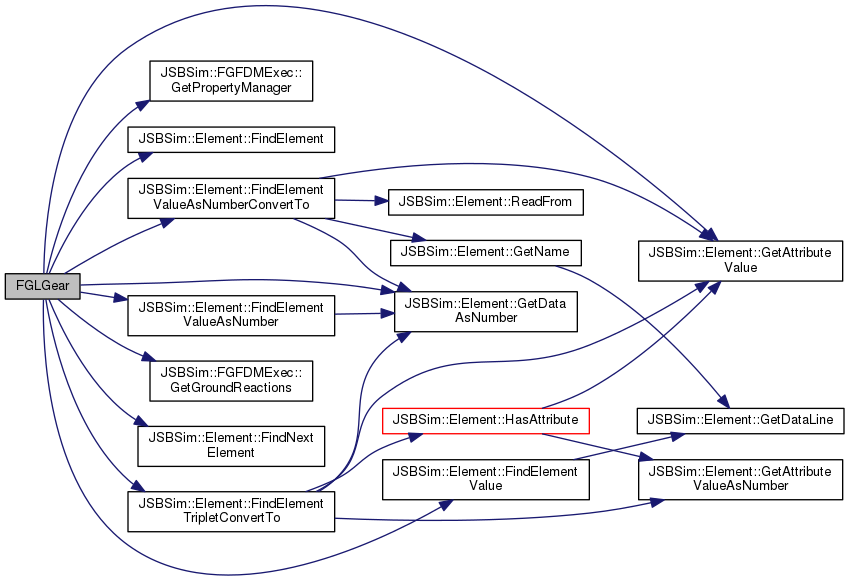
Here is the call graph for this function:| const FGColumnVector3 & GetBodyForces | ( | FGSurface * | surface = NULL | ) |
The Force vector for this gear.
| surface | another surface to interact with, set to NULL for none. |
Definition at line 279 of file FGLGear.cpp.
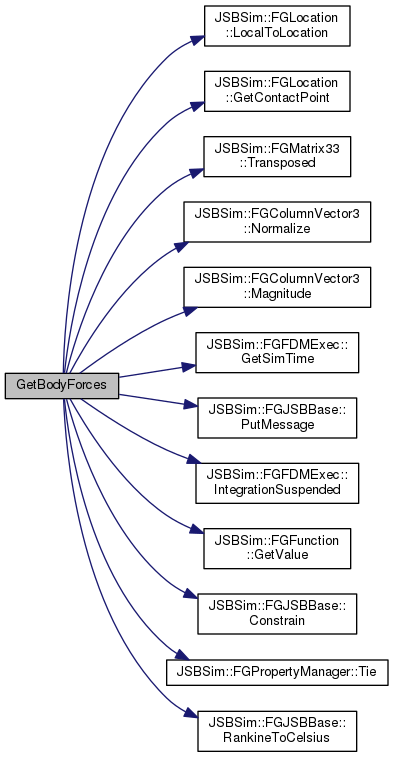
Here is the call graph for this function:
|
inline |
|
inline |
 1.8.13